
Our Curriculum
Classical education grounded in the Great Books and rooted in the Catholic faith.
AN INTEGRATED APPROACH
Classical, Liberal Arts Education
Students at Chesterton Academy enjoy a cohesive, content-rich education. With broad exposure to many disciplines, students expand their interests, uncover hidden talents, and develop the ability to think critically and communicate clearly.
The Great Books
The Chesterton Academy curriculum pursues the transcendentals — the good, the true, and the beautiful. Throughout four years, students are immersed in the primary sources that shaped Western civilization: Homer, Plato, Aristotle, Euclid, Virgil, St. Thomas Aquinas, Dante, Shakespeare, Dostoevsky — and of course, our patron, G.K. Chesterton.
To establish the groundwork of theological thought, students study the Old Testament, the New Testament, and the Catechism of the Catholic Church.
Integration Across Every Subject
Every year, history, literature, philosophy, and theology are braided together within a historical time period. The sciences and humanities are intentionally connected — the logic of mathematics is reflected in the language of philosophy and in God's handiwork in the natural sciences. Faith and reason meet in every class.
Equal emphasis is given to the arts. Every student learns to draw, paint, sing in a choir, and act on a stage.
The Humanities Program
-
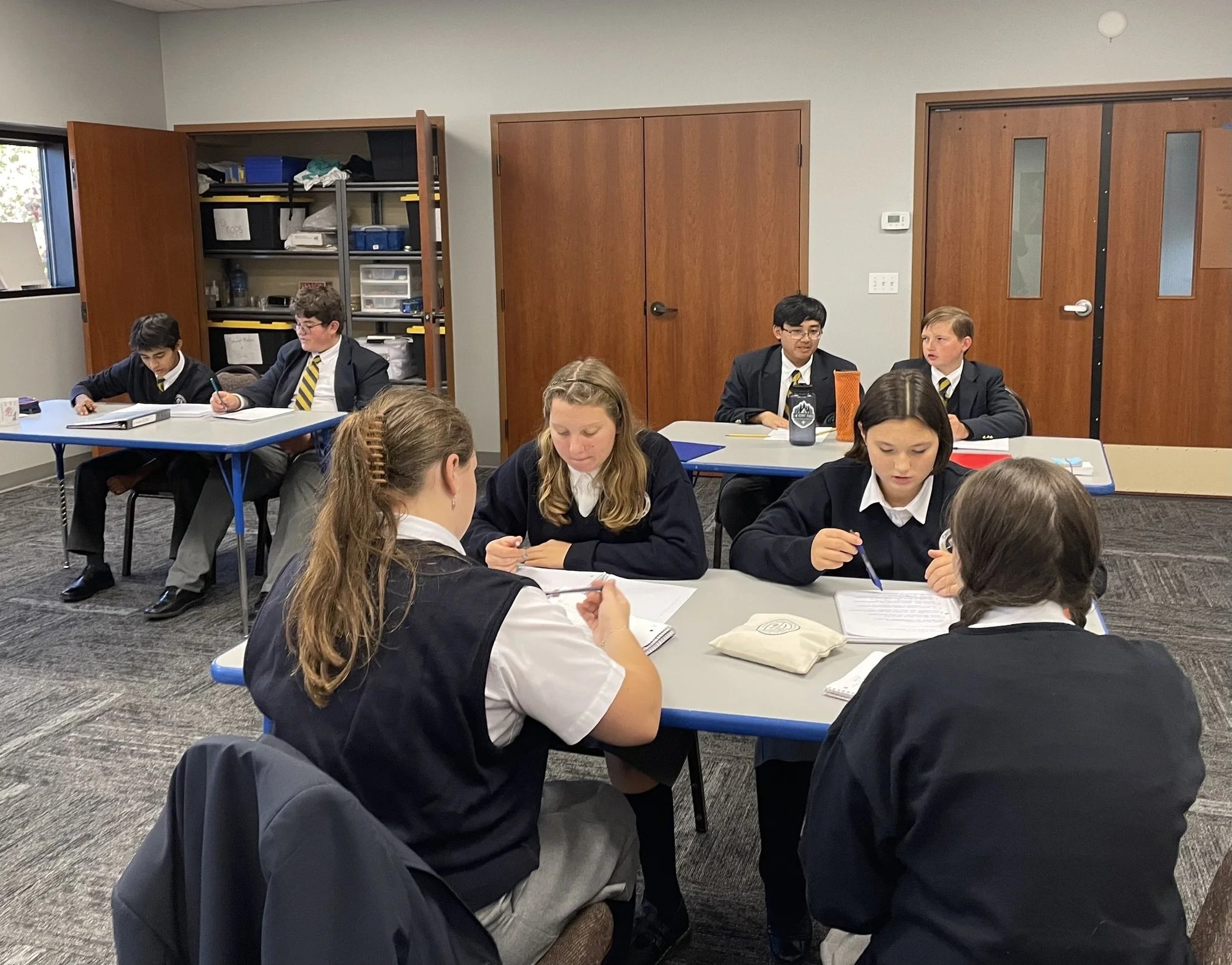
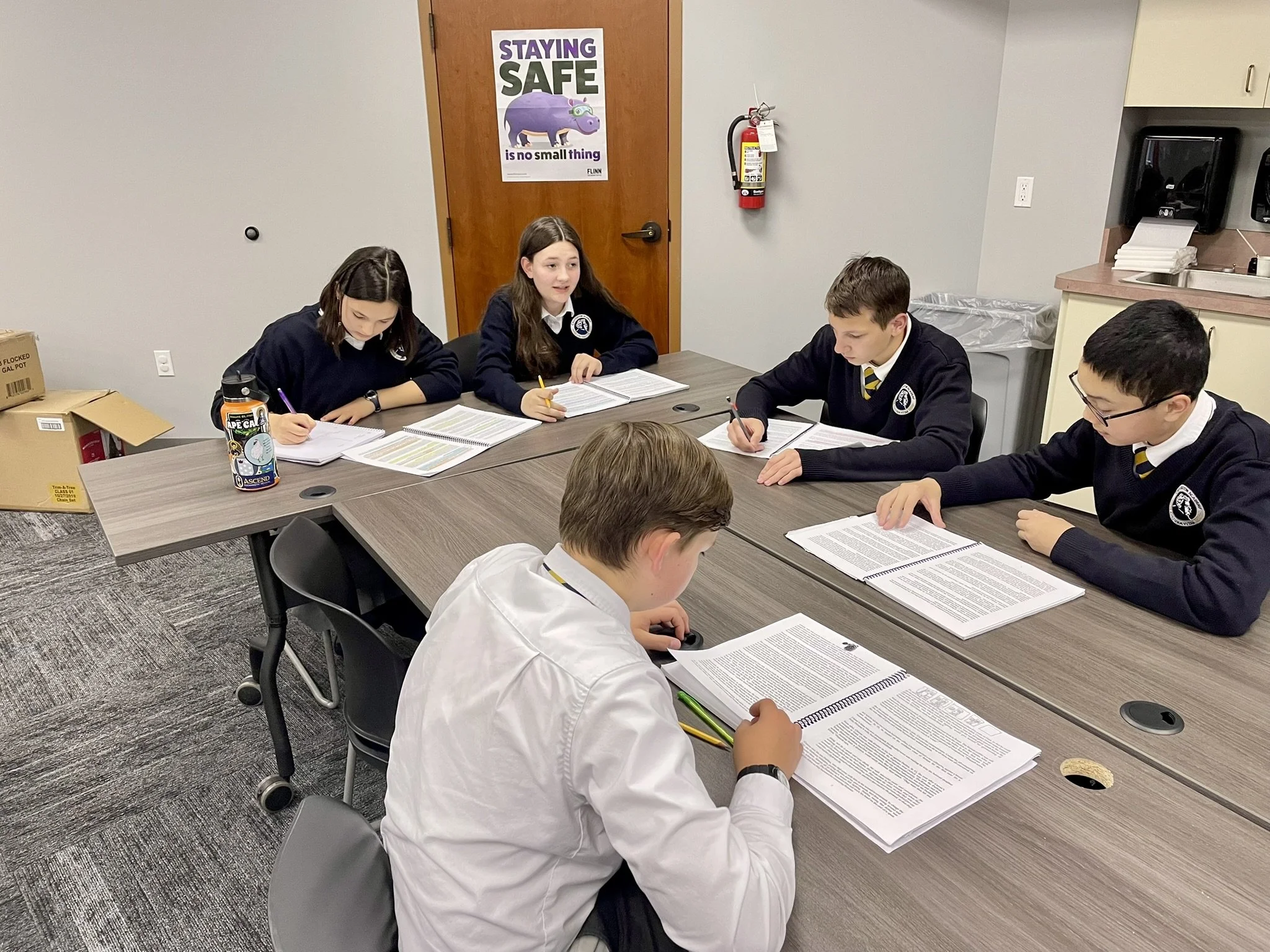
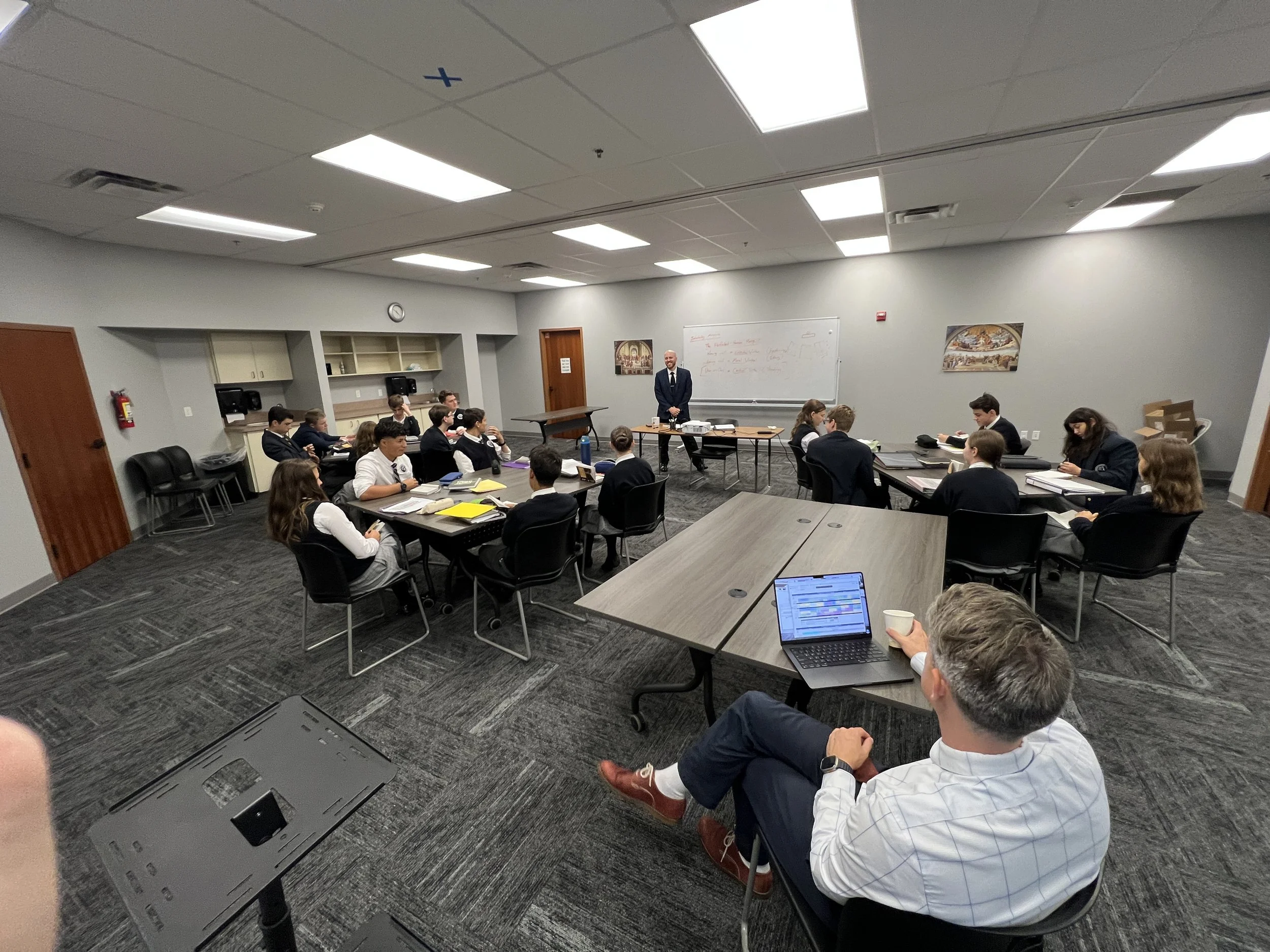
History, literature, philosophy, theology, and languages are braided together in an integrated curriculum utilizing the Socratic Method.
Grade 9: Ancient World
Grade 10: Early Medieval Period
Grade 11: High Middle Ages to the Renaissance
Grade 12: Modern World -
Our study of literature is tied to the study of history and the rest of the humanities. Students are first introduced to the classical epics of Homer and then exposed to early English classics such as The Canterbury Tales and modern literary renderings of medieval history. Moving toward the modern period, they read Dante, Shakespeare, Dickens, Dostoevsky, Chesterton, and American literature. Reading and writing go hand in hand, and each student masters the art of the essay across all subjects.
-
The history classes at Chesterton Academy form the backbone of our curriculum. The four-year sequence covers ancient history through the Greek and Roman civilizations, early Church history, the Middle Ages, the Renaissance, and the Reformation and Counter-Reformation. In senior year, students study the modern era — including the American and French Revolutions, the Industrial Revolution, the Communist Revolution, and the Sexual Revolution. Each history course is tailored to provide a colorful backdrop for literature, art, and science classes.
-
Philosophy — "the love of wisdom" — exercises the brain while it elevates the soul. The ability to understand abstract concepts leads to clear and systematic thinking in all things. We use philosophy to connect the humanities, and to show its obvious connection to logic and mathematics. We study the development of philosophy from its classical roots focusing on Plato and Aristotle, its dramatic encounter with the early Church, its christening by St. Thomas Aquinas, and its deterioration in the modern era.
-
Theology — "the study of God" — is the context by which all other texts are studied. The principal theological texts studied are the Bible and the Catechism of the Catholic Church. We also read selections from the Church Fathers, Documents of the Church Councils, and Papal Encyclicals.
-
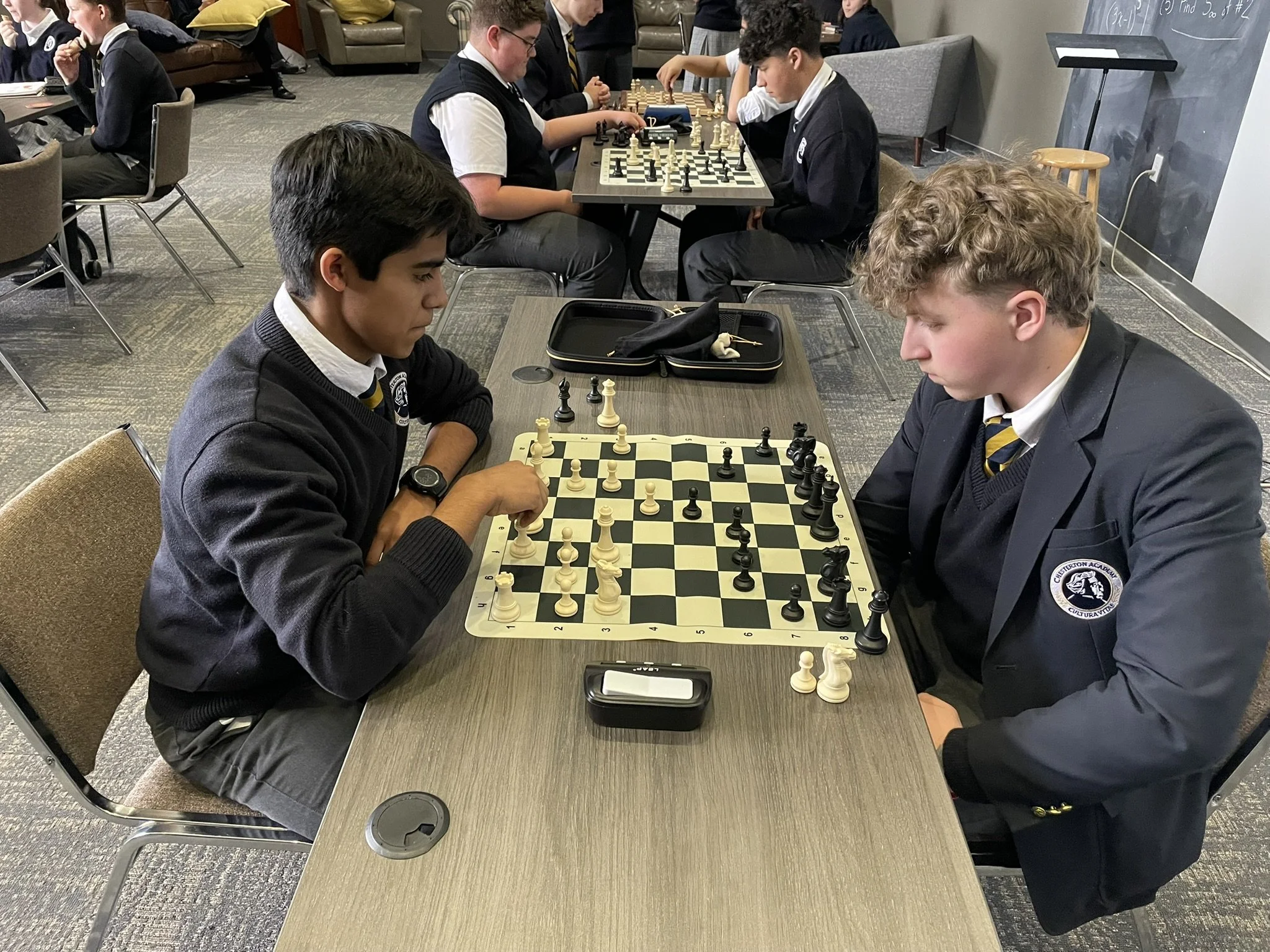
Every student studies Latin — the language of the Church, of law and science, and of much of the Western canon. Far from a dead language, it is the living root of English vocabulary and grammar, a bridge to modern languages like Spanish and French, and a discipline that cultivates the very habits classical education prizes: attention to detail, precision, patience, and honest, careful work. More than that, it deepens everything else our students read — to study Julius Caesar in history and then, months later, encounter his own words in the language in which he wrote them is to meet the great figures of the past face to face, in their original voice.
The Math & Science Program
-
Grade 9: Euclidean Geometry
Grade 10: Algebra II / Trigonometry
Grade 11: Pre-Calculus
Grade 12: Calculus or Statistics -
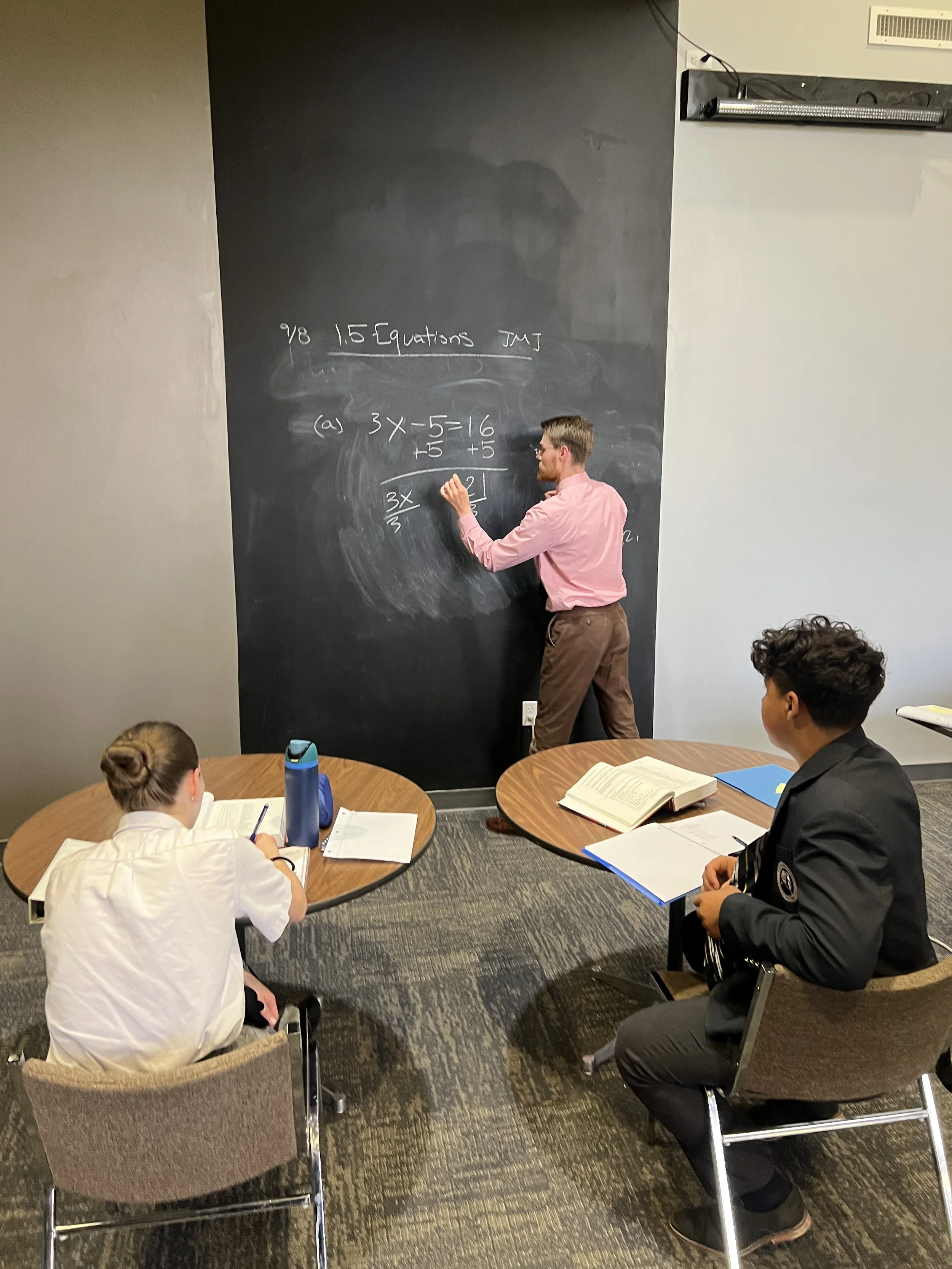
Mathematics is the art of measuring. Science is the study of what can be measured. While math is woven together with the sciences, it is also connected to the humanities — it teaches logic, a basic philosophical principle, and balance, a basic aesthetic principle. Math at Chesterton Academy covers Euclidean geometry and algebra through advanced Calculus. -
Grade 9: Astronomy and Earth Sciences
Grade 10: Biology
Grade 11: Chemistry
Grade 12: Physics -
Science is the study of the physical world — of God's creation. None of these subjects can be approached without a sense of wonder. It is fitting, therefore, to begin by looking up at the heavens: Astronomy. Then we take a look at the world God created (Geology), the creatures He created (Biology), and the intricate substances of which all things are made (Chemistry). We end by gaining an understanding of the nature and properties of matter and energy (Physics).
The Fine Arts
-
Music appeals to the ear and the mind, the emotions and the intellect, the senses and the spirit. Chesterton Academy students are exposed to a wide variety of music that they perform chorally several times a year. An education at Chesterton includes music theory, performance, ear training, note reading, and musical analysis. Music history is taught according with an emphasis on music development within the Church. Students perform in the all-school choir at choir concerts, Masses, and our annual fund raising event. -
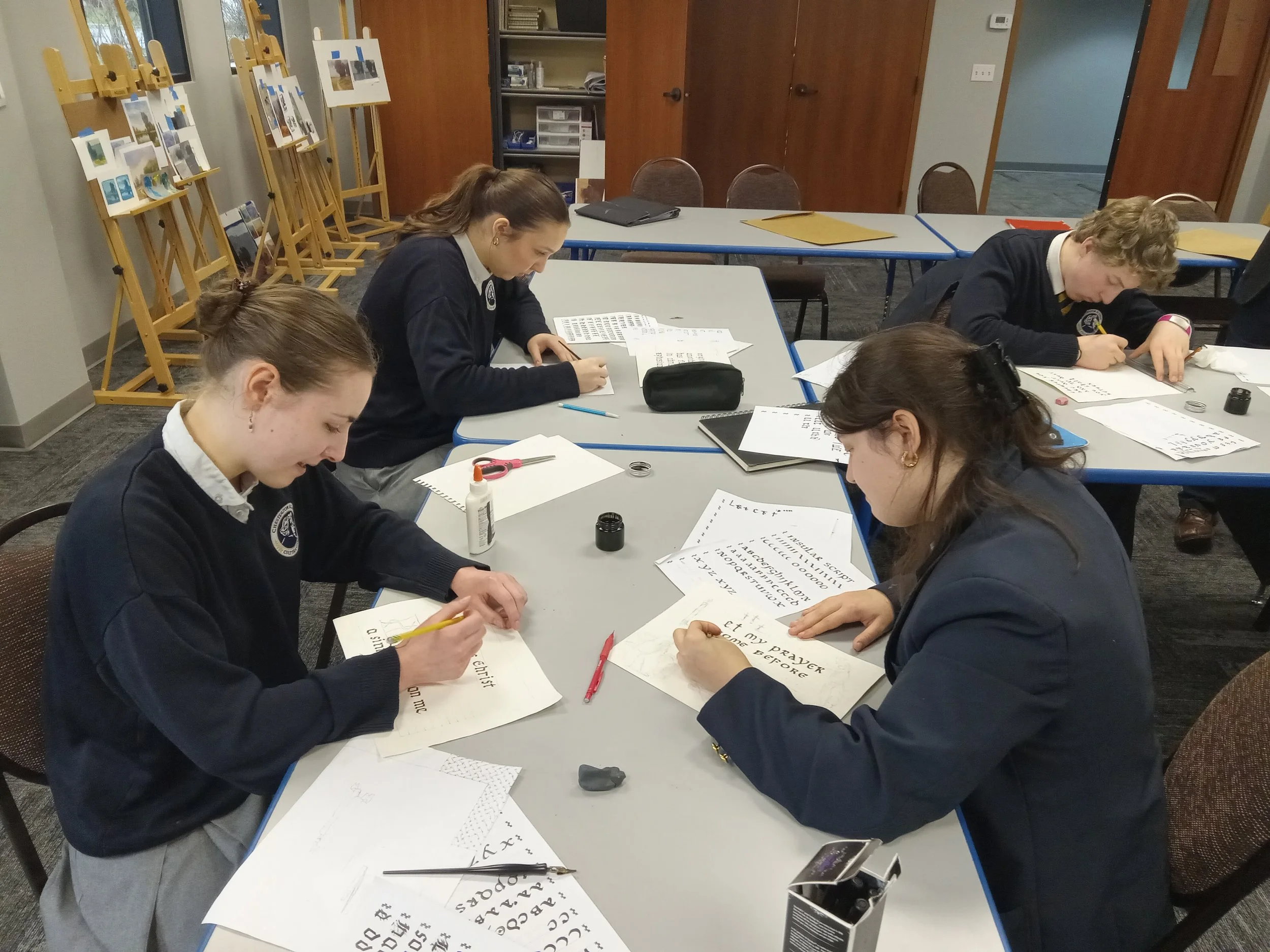
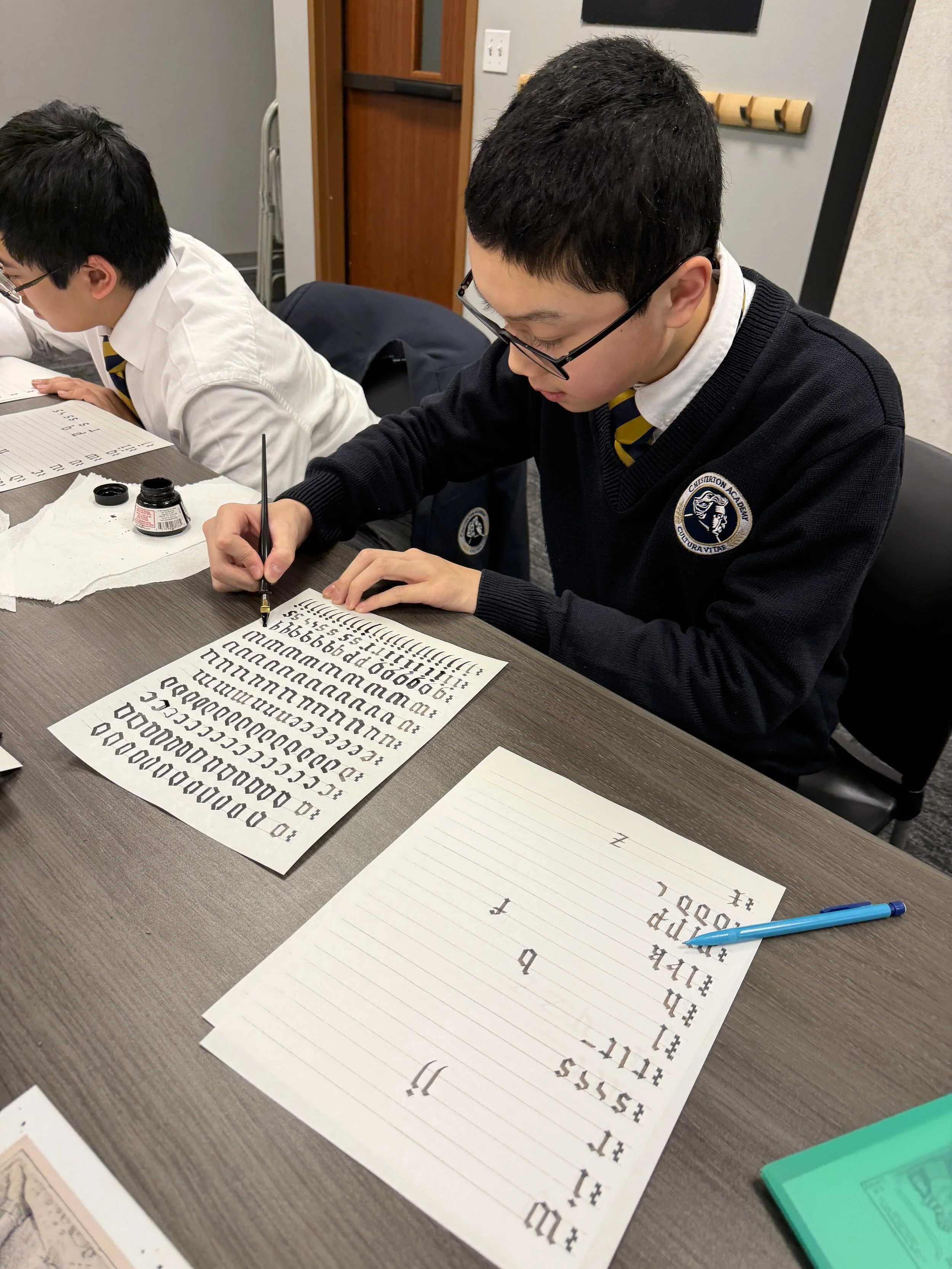
A complete education must include the development of the creative nature and must provide students with the tools and the technique with which to express their ideas, their feelings and their love. It must also include the analytical skills with which to judge a work of art and exposure to great art. Finally, the mechanical skills and the aesthetic aptitude must be put into the proper context of eternal Truth. A good artist is a complete thinker and vice versa. The influence of the arts in today’s society cannot be overstated, and this is why art is mandatory at Chesterton Academy all four years.Grade 9: Ancient Art History | Drawing and Calligraphy
Grade 10: Late Roman and Early European Art History | Charcoal and Acrylics
Grade 11: Late Gothic, Renaissance, and Baroque Art History | Oils
Grade 12: Classical, Romantic, and Modern Art History | Oils -
The dramatic arts are particularly powerful in our present culture where movies and the media are often the primary source of knowledge and ideas for many young people. Drama involves the study of how words are brought to life, and in order to successfully do this on stage the actor must learn to see the work as a whole, to understand the author’s vision and the time in which it was written. In other words, the actor must learn to be a good literary critic, philosopher, and historian. Drama ties together the information students learn in the classroom and asks them to actively participate in its performance, and thus drama is required for all students, and each year culminates in a full-length play.
Each year builds on the previous, so that by senior year our students develop into articulate, clear-thinking, well-rounded, and joyful individuals. Our students exceed the national average on standardized tests — but our mission does not end with getting students into college, trades or the military. We desire all our students to get to heaven!